How to Rank in Google AI Overviews: Strategies That Actually Work
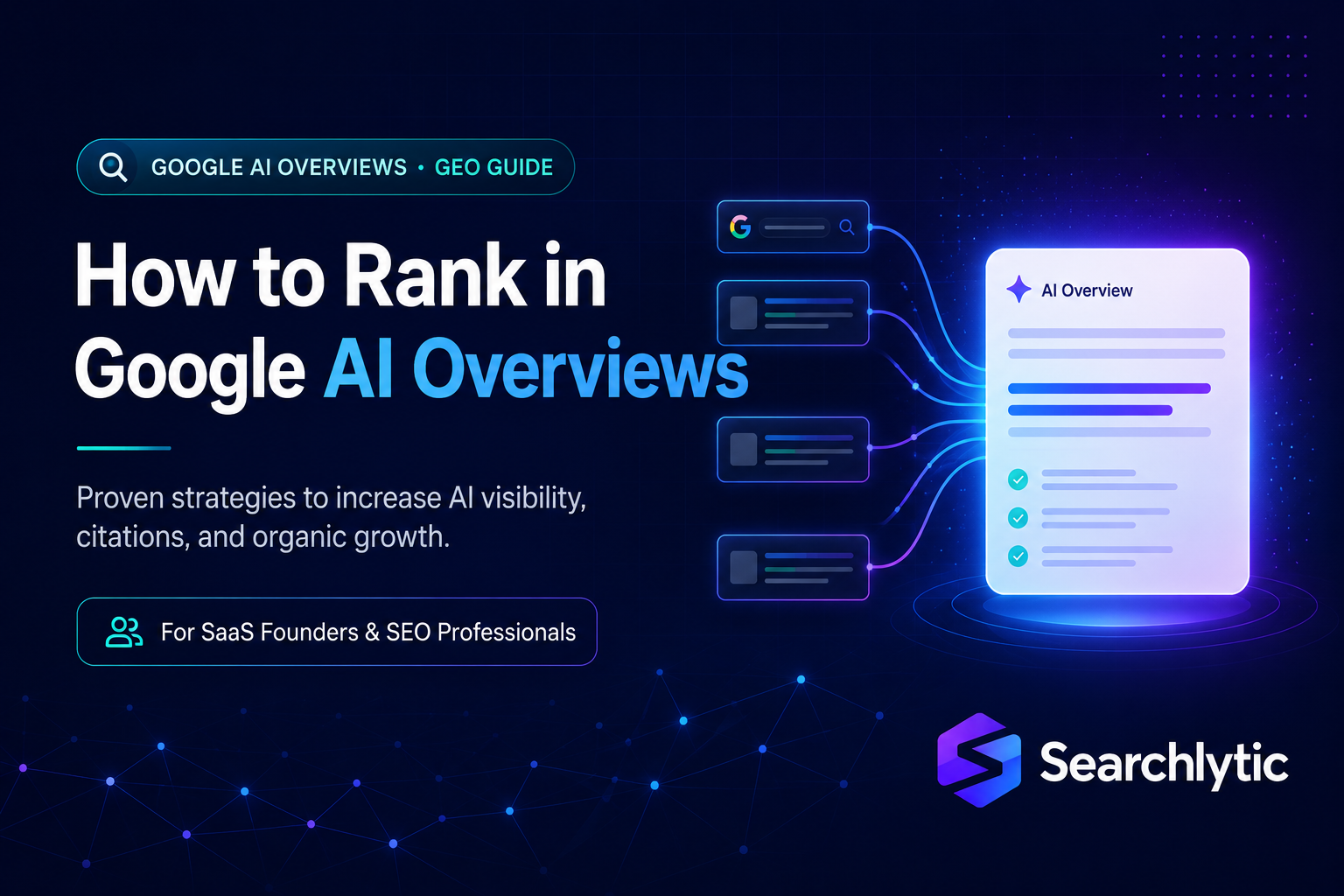
Search experience is shifting rapidly. With Google expanding AI Overviews (AIO) alongside the rise of LLMs like ChatGPT, Perplexity, and Gemini, traditional SEO alone no longer guarantees brand visibility.
For SaaS Founders and SEO Professionals, the game has evolved from winning a standard blue link to becoming the default source cited by generative engines.
If you want your platform to be . recommended inside Google's AI-generated snapshots, you need a strategy blending GEO (Generative Engine Optimization), AEO (Answer Engine Optimization), and strong Entity SEO.
Here is an actionable, high-visibility playbook to capture real estate in Google AI Overviews.
1. Optimize for Entity-First Architecture & Schema Engineering
Google’s Gemini models process information through entities—people, products, SaaS solutions, and concepts—and the semantic relationships between them. If AI engines cannot clearly map who you are and what problem you solve, you will be ignored in AIO.
Execution Blueprint:
• Implement Advanced Schema: Beyond standard article schema, implement SoftwareApplication, Organization, and FAQPage schema. Explicitly use sameAs attributes linking to your official social profiles, Crunchbase, and Wikipedia entries.
• Build Contextual Entity Hubs: Group related topics into dedicated content clusters that reinforce your primary software category.
• Internal Linking: To evaluate your platform’s presence across LLMs, conduct a comprehensive audit through Searchlytic to identify missing entity signals.
2. Structure Content with "Answer-First" (AEO) Formatting
Google AI Overviews extract concise, clear, and direct answers from web pages to compile summaries. Dense, fluff-heavy intros will cause the model to pass over your content.
Execution Blueprint:
• The BLUF Method (Bottom Line Up Front): Place a 40–60 word direct answer immediately under your H2 or H3 heading before diving into detailed explanations.
• Data-Dense Lists: Generative models prefer structured formatting like bulleted feature comparisons and direct pros/cons over unformatted paragraphs.
• Target High-Intent Conversational Queries: Create content structured around long-tail, natural language questions (e.g., "How does [SaaS Category] integration work with existing CRMs?").
3. Establish Digital PR & Third-Party Citation Proof
Google AIO rarely relies on a single source. It uses a process called query fan-out, running multiple sub-queries behind the scenes to verify facts across the web. If third-party sources do not cite your product, your on-page claims lose trust.
Execution Blueprint:
• Win Unbranded Mentions: Focus on getting listed on industry review platforms (G2, Capterra, Gartner), news sites, and niche tech blogs.
• Strengthen Off-Page Signals: Publish original research, benchmarking reports, or original data that journalists and industry blogs cite.
• Internal Linking: Partnering with specialized teams via Searchlytic Growth Solutions allows SaaS brands to engineer off-page digital PR footprints that LLMs favor.
4. Strengthen Technical Crawlability & Core Web Vitals
If Googlebot or AI crawlers encounter indexability issues, your content won't make it into the candidate pool for AI Overviews.
Execution Blueprint:
• Remove Crawl Blockers: Ensure your robots.txt does not accidentally block Google's retrieval agents and check for noindex tags on priority pages.
• Streamline Site Architecture: Keep critical SaaS features, comparison pages, and solution pages within 3 clicks of the homepage.
• Internal Linking: Run a thorough technical audit using Searchlytic SEO Solutions to eliminate indexability bottlenecks.
5. Implement Internal Linking for Topical Authority
Internal linking is the single most controllable lever to guide Google's AI through your content hierarchy and signal topical authority.
Internal Linking Rules for AI Overviews:
• Descriptive Anchor Text: Never use generic anchors like "click here" or "read more". Use descriptive, entity-rich anchors like Entity Optimization Framework or AEO Services.
• Hub-and-Spoke Architecture: Link child articles back to the parent pillar page and cross-link between relevant child guides.
• Contextual Placement: Insert internal links early in the body copy where relevant context is being discussed, helping AI crawlers map related topics easily.
Strategic Summary for Growth Teams
• Traditional SEO Focus: Rank top blue links, focus on keyword density, long-form content, and PageRank link quantity.
• AI Overview (GEO/AEO) Focus: Get cited inside the AI snapshot, focus on answer-first structured text, entity validation, third-party citations, and AI Share of Voice.
Ready to Claim Your Space in Modern Search?
Winning in Google AI Overviews requires moving beyond legacy SEO checklists. You need an integrated approach across SEO, AEO, and GEO to position your software where modern buyers are looking.
Discover how Searchlytic helps SaaS brands and growing businesses build the content, authority, and entity signals that win Google, ChatGPT, Perplexity, and Gemini.