The Complete GEO Strategy Guide for 2026: How to Win Generative AI Search & AI Overviews
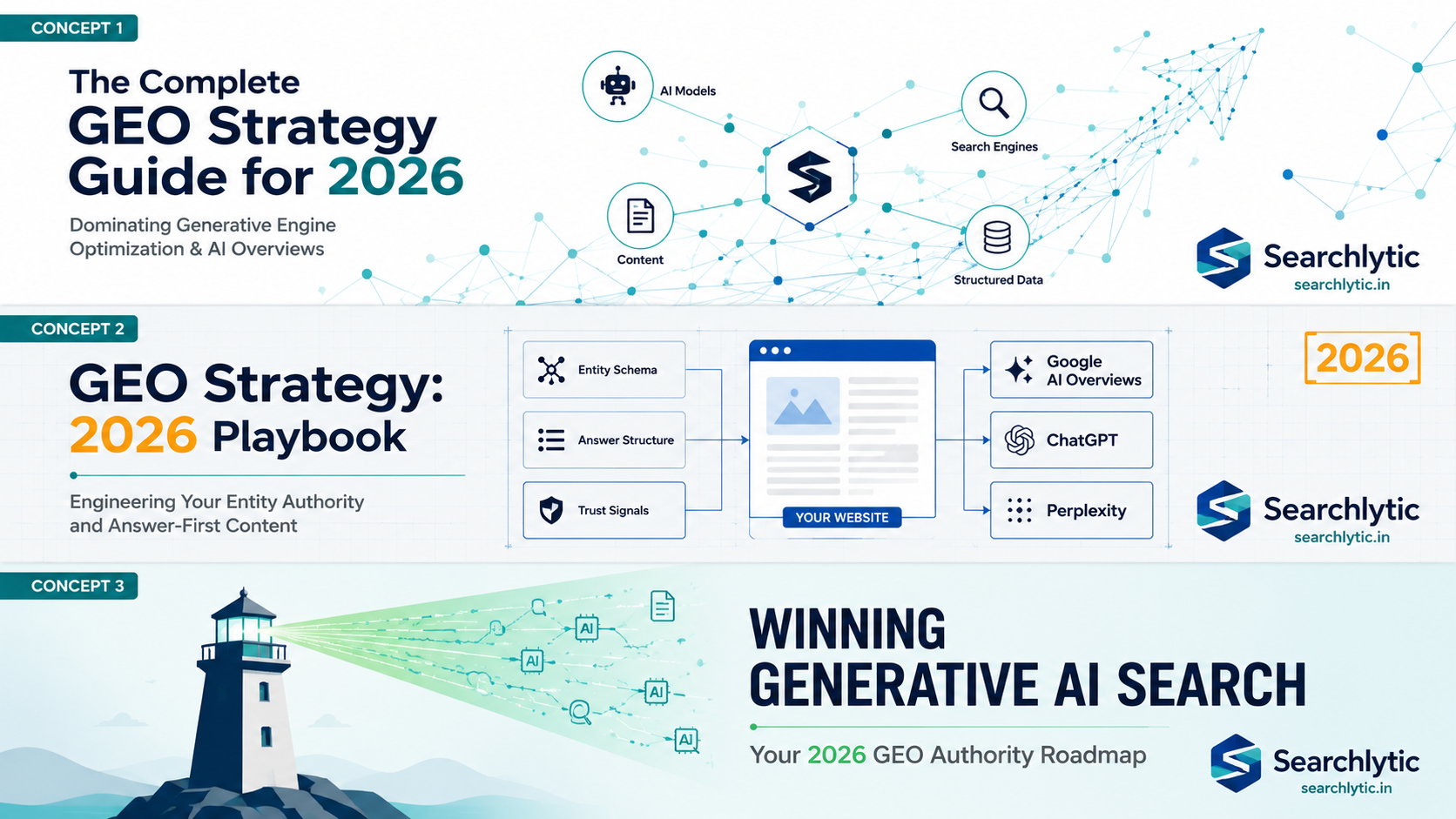
The Complete GEO Strategy Guide for 2026: How to Win Generative AI Search & AI Overviews
The traditional search landscape has fundamentally shifted. Ranking #1 on Google’s traditional blue links is no longer sufficient to dominate your industry. Buyers, enterprise decision-makers, and consumers are increasingly turning to generative AI engines—including Google AI Overviews, ChatGPT, Perplexity, Gemini, and Claude—for direct answers, product recommendations, and vendor comparisons
To stay relevant, modern growth teams must evolve from purely tactical SEO to Generative Engine Optimization (GEO) and Answer Engine Optimization (AEO).
In this comprehensive 2026 playbook, we break down the exact strategies required to build topical authority, engineer entity-based relationships, and turn your brand into the default citation across major LLM-driven engines.
What is GEO (Generative Engine Optimization)?
Generative Engine Optimization (GEO) is the practice of optimizing digital content, brand entities, and online footprint to ensure your brand is cited, recommended, and surfaced inside Generative AI search results and conversational AI assistants.
While traditional SEO focuses on driving clicks via ranking algorithms, GEO focuses on:
LLM Extraction Efficiency: How easily Large Language Models (LLMs) parse and synthesize your data.
Topical & Entity Authority: How confidently an AI model associates your brand with specific industries, solutions, and queries.
Citation Ecosystems: Building multi-platform validation across high-trust third-party nodes
For a deeper dive into tailored enterprise execution, explore our dedicated GEO Optimization Services.
3 Core Pillars of the 2026 GEO Framework
Pillar 1: Entity & Knowledge Graph Engineering :
LLMs do not read words the way humans do; they parse relationships between entities (people, places, concepts, products, and organizations).
1. Structured Data & JSON-LD Expansion:
Implement hyper-specific schema markup (Organization, Service, TechArticle, FAQPage, and AboutPage) with explicit sameAs attributes pointing to verified external knowledge nodes (Wikidata, Wikipedia, Crunchbase, LinkedIn, official industry registries)
2. Entity Home Optimization:
Designate clear "Entity Home" pages on your website (such as your About Searchlytic page) that explicitly define who you are, what you solve, and what topical categories you own
3. Co-Occurrence Signals:
Ensure your brand name consistently co-occurs in unstructured web data alongside your primary industry terms (e.g., "Searchlytic + Generative Engine Optimization")
Learn how we map and strengthen your brand's Knowledge Graph with our Entity & AI Visibility Services.
Pillar 2: Content & Answer-First Architecture (AEO)
Generative models prioritize content that directly, unambiguously answers the user's explicit and implicit prompts.
Extractable Data Structures: Use clean HTML tables, ordered lists, structured bullet points, and high-density data metrics. LLMs extract structured tables at significantly higher rates for comparison prompts.
Topical Cluster Mastery: Instead of isolated blog posts, deploy comprehensive content hubs that cover every sub-intent surrounding a core topic.
If you are looking to capture zero-click answers and featured snippets, review our specialized AEO Strategy Services.
Pillar 3: Off-Page Citation & Recommendation Ecosystem
AI engines do not rely solely on your website; they crawl third-party consensus to verify your brand's authority.
Digital PR & Digital Ecosystem Placement: Being mentioned in high-tier publications, industry review platforms (G2, Clutch, Capterra), and authoritative media outlets builds the consensus layer LLMs require before recommending your product.
Community & Forum Presence: Active discussions on Reddit, Quora, specialized forums, and GitHub serve as primary training and real-time retrieval data for models like ChatGPT and Perplexity.
Unbranded Mention Frequency: Drive consistent mentions across podcasts, guest articles, and partner websites to maximize share-of-voice across modern prompt landscapes
How Searchlytic Drives Measurable AI Visibility
Navigating the shift to generative search requires an integrated approach to technology, content, and brand authority. At Searchlytic, we bring strategy, technical execution, and revenue attribution under one roof:
Searchlytic Launch: Ideal for startups and new ventures looking to build an AI-native digital foundation, structured schema, and go-to-market positioning right from day one.
Searchlytic Growth: Tailored for scaling businesses aiming to compound organic search, expand AI citations across LLMs, and gain market share.
Searchlytic Transformation: Designed for enterprise organizations needing to modernize legacy SEO architecture and adopt AI-first discovery workflows.
SEO Growth Partner: Long-term, senior-led execution designed to compound topical authority and long-tail AI reach.
Business Growth Consulting: Holistic strategic consulting that aligns search performance with pipeline and bottom-line reve
nue.
Ready to Claim Your Brand's Share of Voice in AI Search?
Don't let your competitors become the default answer in ChatGPT, Perplexity, and Google AI Overviews.
Get a complete analysis of your brand's entity health, topical coverage, and current LLM visibility:
👉 Request Your Free Business Growth Audit — Receive a tailored, actionable 90-day execution roadmap from our senior operators within 1 business day.
Have questions? Connect directly with our team via our Contact Page or explore our insights on the Searchlytic Blog.